You are viewing 1 of your 1 free articles
Can we improve conditions in temporary accommodation?
Inside Housing columnist Jules Birch analyses the latest report from the Housing, Communities and Local Government Committee


 Can we improve conditions in temporary accommodation? #UKhousingInside Housing columnist Jules Birch analyses the latest report from the Housing, Communities and Local Government Committee #UKhousing
What do you call something that’s not permanent but no longer temporary?
‘Temporary’ no longer seems an adequate way to describe accommodation that has become ‘home’ for families with children for two to five years, or much longer in some cases.
Matt Downie, chief executive of homelessness charity Crisis, told the Housing, Communities and Local Government (HCLG) Committee that this grim situation has become “a normalised emergency” – but how long can an ‘emergency’ go on before it is no longer an emergency?
As he put it: “When the records are broken every time the statistics come through, not just for overall temporary accommodation but for children in temporary accommodation or any other way you seek to cut the data, there appears to be no way of generating greater political expediency through the statistics, because they are normalised.”
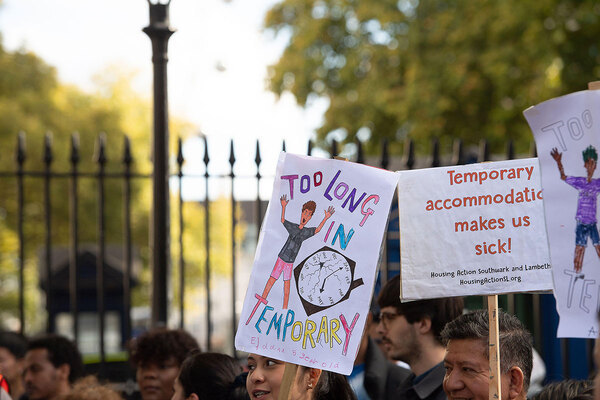
The report published by the HCLG Committee today (Wednesday 22 April) repeats many of the same recommendations it made a year ago about the “utterly shameful” situation facing 164,000 children in temporary accommodation and the consequences to their health, well-being, safety and education.
A world where words have either lost their meaning or their ability to shock is one where we come to accept the unacceptable.
Since then, the government has published its National Plan to End Homelessness, which promises to increase the supply and improve the quality of temporary accommodation. There are now almost 176,000 children living in temporary housing. The plan also set a national target to eliminate the unlawful use of B&Bs for families and there has been good news on that front, with the number of families in B&Bs beyond the six-week legal limit falling from 4,000 in June 2024 to 1,640 in September 2025.
That is real progress, but the total is still three times higher than at the end of 2021 and 10 times higher than when Labour was last in government in 2010. And these numbers do not include families in other accommodation with shared facilities that do not qualify as B&Bs because they are not privately managed.
The committee says that it should be possible to eliminate the unlawful use of B&Bs by the end of the parliament, but warns that “there are risks that councils may resort to increasing their use of out-of-area placements or other shared accommodation that is potentially unsuitable”.
In some cases, it heard, landlords of B&Bs have converted properties into self-contained studios that fall outside the definition of a B&B but still have the same shared facilities.
The HCLG Committee’s last report asked whether the six-week limit should apply to ‘non-self-contained’ accommodation rather than narrowly defined B&Bs, but the government’s response argued that accommodation with shared facilities was a “necessary stepping stone” for families.
The contradictions do not stop there. On disrepair, the MPs heard evidence that the most serious Category 1 hazards are “commonplace” in temporary accommodation and was told of one child being bitten on the toe by a rat and another waking up covered in ants.
The committee recommends that the government should begin to roll out Awaab’s Law and ensure that the regulations are fully applied to temporary accommodation by the end of 2028-29.
The government also plans to apply the revised Decent Homes Standard to all forms of temporary accommodation from 2035. Charities and consumer groups want it much sooner, but councils warned that applying the standard in temporary housing before the rest of the private rented sector could have unintended consequences for supply and landlords’ ability to comply with their legal duties. So we must wait another nine years.
The biggest dilemmas – and contradictions – come in managing and improving the supply of temporary accommodation.
For starters, the number of families living in temporary accommodation owned by the council or a housing association has quadrupled since 2011. This may be empty flats designated for demolition and regeneration, but the committee heard evidence of one council that was considering using blocks with “significant fire risks”.
In the private sector, use of nightly paid accommodation for families with children has doubled since 2022 and is 15 times higher than in 2010. In many cases, landlords have terminated longer-term leases and shifted families to nightly paid accommodation because returns are higher.
As temporary becomes even more temporary, councils are stuck in a “vicious circle” of costs that are escalating at the same time as subsidy rates are frozen at 90% of Local Housing Allowance rates from 2011.
“The government has acknowledged the issue of competition between different arms of government and is working to test new ways to procure accommodation”
Commissioning higher-quality accommodation could effectively leave councils bankrupt as subsidy rates do not come close to covering the market return on the property. That leaves them battling it out at the poor-quality end of the market, strengthening the hand of landlords and leaving them no incentive to improve standards.
To make matters even worse, councils are not just up against each other for properties. One charity told the HCLG Committee that in Newham, the council is not just competing against other London boroughs but also the Home Office and sometimes even its own children’s services department. So, the council “often loses out as others are prepared to pay more for lower standards in the borough”.
The committee also heard evidence of “devastating” unintended consequences if the government tries to raise the standard of temporary accommodation before other parts of the private rented market.
The government has acknowledged the issue of competition between different arms of government and is working to test new ways to procure accommodation. However, the report says: “We are disappointed that the National Plan to End Homelessness did not include a firmer stance on eliminating this unhelpful practice.”
The committee welcomes the £950m available through the Local Authority Housing Fund over the next four years to increase the supply of temporary accommodation via building, conversions and acquisitions. But it also heard concerns about “stop-gap, shorter-term solutions” such as converted offices and shipping containers.
In the final analysis, of course, the only solution to the temporary accommodation problem is more permanent homes. “Boosting the supply of affordable homes, especially social housing, is critical to alleviating the crisis in temporary accommodation,” the HCLG Committee argues.
Strangely, though, it does not repeat the call consistently made before the general election by its predecessor committees for 90,000 social rented homes a year to meet housing need.
Short-term fixes can only take us so far. Temporary must become permanent.
Jules Birch, columnist, Inside Housing
Sign up to Inside Housing’s Homelessness newsletter
Sign up to Inside Housing’s Homelessness newsletter, a fortnightly round-up of the key news and insight for stories on homelessness and rough sleeping.
Already have an account? Click here to manage your newsletters.
Related stories